
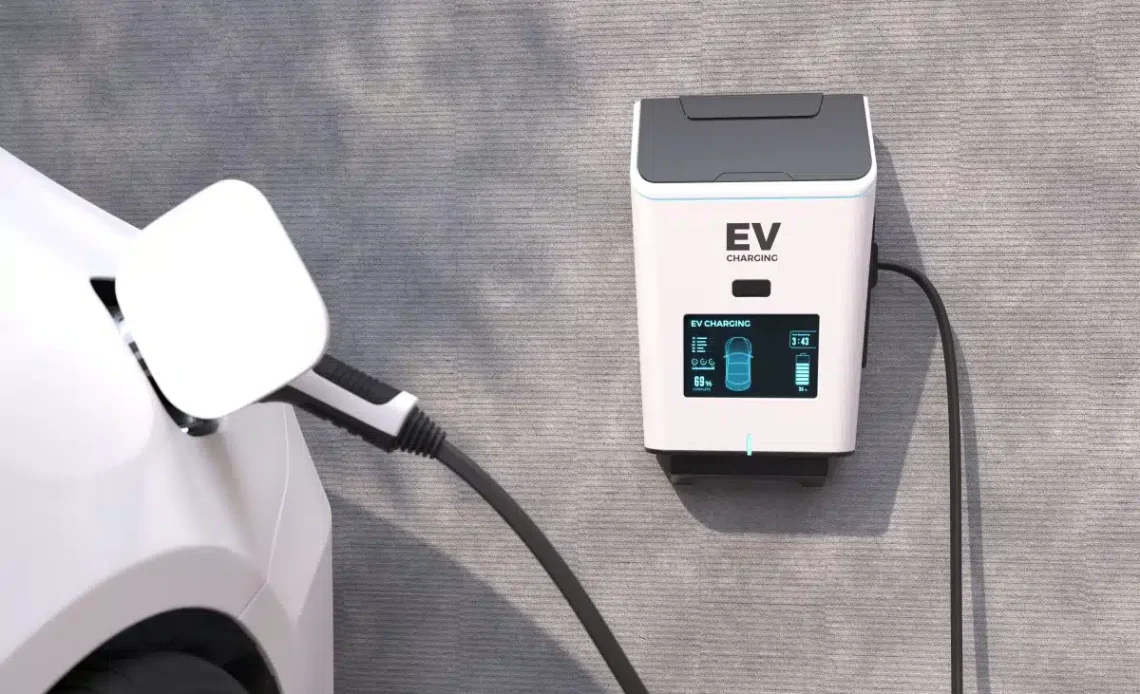
Plug your new EV into a standard wall outlet and you’ll get roughly 4 miles of range per hour. Drive 40 miles tomorrow and that outlet will need about 10 hours to put the miles back. For a lot of people, that math quietly kills the whole “charge overnight” promise that made EVs appealing in the first place.
The fix is straightforward, but choosing wrong can cost you either money you didn’t need to spend or a charging setup that leaves you frustrated every morning. This guide runs through both levels honestly, shows you what each costs in 2026, and gives you a concrete framework for picking the right one for your house.
What “Level” Actually Means
Charging levels are just shorthand for voltage and speed. There are three tiers:
- Level 1: Your standard 120V household outlet. No additional hardware required, just the cord that shipped with your car. Output is roughly 1.3 to 2.4 kW.
- Level 2: A dedicated 240V circuit, the same voltage your dryer or electric range runs on. Output typically runs from 7 to 11 kW for home units.
- DC Fast Charging (Level 3): Commercial-grade hardware you won’t find in a home. This is the station at a highway rest stop that gets you to 80% in 20 minutes.
For home use, you’re choosing between Level 1 and Level 2. That’s the real decision.
The Speed Gap Is Bigger Than It Looks
Level 1 delivers 3 to 5 miles of range per hour. Level 2 delivers 25 to 44 miles of range per hour, depending on your car’s onboard charger. That’s not a modest improvement. A 60 kWh battery pack that takes 30+ hours to fully charge on a Level 1 outlet takes 6 to 8 hours on a Level 2 unit.
For most American commuters, a Level 1 charger technically works. If you drive under 30 miles a day and you’re home for 10 or more hours overnight, a wall outlet can keep pace. That’s genuinely fine for a plug-in hybrid or a light commuter situation.
But here’s where the math shifts. In 2024, new EV sales reached 1.56 million, representing about 10% of all new light-duty vehicles sold in the United States, according to the International Council on Clean Transportation (April 2025). Most of those buyers are purchasing fully electric vehicles with larger battery packs, often 70 to 100 kWh. A Level 1 charger on a 77 kWh pack is not a realistic daily charging solution. You’d be running a deficit on any day you drive more than 35 miles, and those deficits compound over the week.
What a Level 2 Installation Actually Costs
The hardware itself, a wall-mounted 240V charger from brands like ChargePoint, Wallbox, or Grizzl-E, runs $400 to $1,200 depending on amperage and smart features. The installation is the variable that surprises people.
Most U.S. homeowners pay roughly $1,200 to $3,000 for a professionally installed Level 2 home charger in 2025 to 2026, before incentives, according to installation data compiled by Recharged. Simple installs where your panel has room and the garage is close to the breaker box land well under $1,500. Jobs that require a panel upgrade or long conduit runs can push past $4,000.
One thing that saves a lot of people money: bundling the EV charger install with another electrical project you were already planning. A panel upgrade you needed anyway suddenly becomes shared labor. Some homeowners see 30% or more knocked off the total bill that way.
On the incentive side, the federal Alternative Fuel Vehicle Refueling Property Tax Credit covers 30% of installation costs up to $1,000 through 2032. Several states layer additional rebates on top of that, and many utilities run their own programs. Check the Alternative Fuels Data Center at the U.S. Department of Energy for programs specific to your ZIP code. The Northeast region recorded the largest increase in public EV charging ports of any region in Q2 2024, rising 13.2%, per the Alternative Fuels Data Center’s quarterly infrastructure trends report (2024), which signals growing state-level investment in EV infrastructure across the region.
The CHARGE Framework: A Decision Tool for Homeowners
This is the framework I’d run through before calling any electrician. Five questions. If you answer yes to three or more, Level 2 is the right call.
| Question | Level 1 Friendly | Level 2 Territory |
|---|---|---|
| C – Commute over 35 miles daily? | No | Yes |
| H – Hours home per night under 10? | No | Yes |
| A – All-electric (not plug-in hybrid)? | No | Yes |
| R – Road trips or weekend drives common? | No | Yes |
| G – Garage or dedicated parking available? | No | Yes |
| E – Expecting to add a second EV? | No | Yes |
Three or more “yes” answers and the economics of Level 2 pay off inside two years for most drivers. Four or more and there’s really no argument for staying on a wall outlet.
A Realistic New England Scenario
Picture a homeowner in southern New Hampshire with a 2024 Chevy Equinox EV, a 85 kWh battery, and a 45-mile daily round-trip commute to Manchester. On a Level 1 charger, she’d recover about 50 miles overnight on a best-case 10-hour charge window. That just barely keeps pace, with zero buffer for a weekend drive to the White Mountains or a cold January morning that eats extra battery.
A Level 2 install in that garage takes her from “barely keeping up” to “waking up to a full charge every single day.” On a 48-amp Level 2 unit, the Equinox EV charges fully in about 7 hours. She gains genuine flexibility, the kind that makes an EV feel like an EV instead of a math problem.
“The vast majority of EV drivers who experience Level 2 home charging report they would not go back to Level 1, regardless of their commute length. Overnight top-offs become effortless, which changes how people use their cars.” – Consensus finding across multiple EV owner surveys, including data reported by the International Council on Clean Transportation in their 2024 infrastructure deployment analysis.
Getting that install done right matters too, especially in older New England housing stock where panels from the 1980s may need evaluation before adding a 240V circuit. That’s exactly why working with qualified home charging station electricians in New Hampshire matters: someone who knows local code, can assess your panel honestly, and pulls the right permits, rather than leaving you with an unpermitted circuit that could complicate a future home sale.
When Level 1 Is Actually Enough
Not every situation calls for a Level 2 upgrade, and it’s worth saying that plainly. If you drive a plug-in hybrid with a 15 to 25 mile electric range, a standard outlet replenishes that battery fully overnight with room to spare. Spending $1,500 on a Level 2 install for a car that only needs 2 hours of charging is unnecessary.
Similarly, apartment dwellers or renters without dedicated parking often can’t install a Level 2 unit anyway. In that case, rely on workplace charging or public infrastructure during the day and use Level 1 when you’re home. It’s a workable strategy while your living situation stays flexible.
The One Upgrade You Won’t Regret
If you’ve bought a fully electric vehicle with a large battery pack, or you’re planning to, Level 2 is not a luxury. It’s the baseline that makes EV ownership match the promise. The installation cost is real, but it’s a one-time expense against years of waking up to a full charge, paying residential electricity rates instead of public charging prices, and never hunting for an open station on a Saturday morning.
Run the CHARGE framework. If the numbers land on Level 2, get a licensed electrician in to assess your panel before you pick your hardware. The panel assessment is usually free, it takes 20 minutes, and it tells you exactly what the job will cost before you commit to anything.