
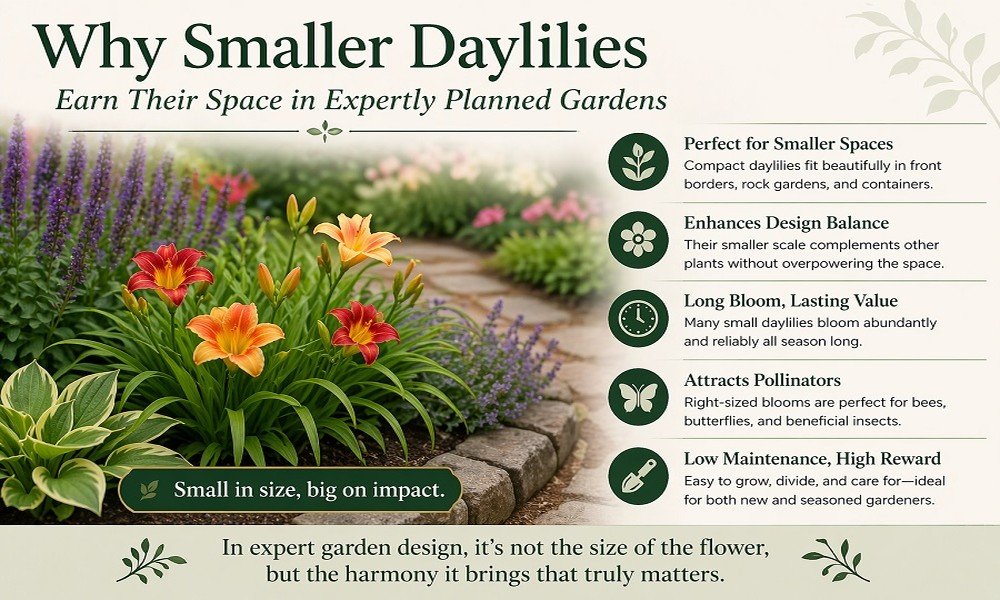
Small daylilies are often treated as a niche option, yet in well-planned gardens they solve several common design problems better than many larger cultivars. They fit narrower borders, hold their shape without dominating neighbouring plants, and offer flowers at a height that works well in front-of-border planting schemes, terrace beds, courtyard spaces and smaller domestic plots. For British gardeners dealing with compact gardens, mixed planting and the need for a long season of interest, that makes them far more useful than their size first suggests.
Their value is not limited to small gardens. In larger landscapes, miniature and small-flowered daylilies can provide proportion, rhythm and visual relief between bolder shrubs, grasses and perennials. They are also easier to repeat across a design without making the planting look heavy. Where full-sized daylilies can become visually dense, smaller forms often look more precise and more intentional.
Specialist commentary from the premier grower of daylily plants SwallowtailDaylilies: “In gardens where scale matters, small daylilies plants for sale deserve serious consideration because they combine reliable flowering with a more disciplined presence in mixed planting. They are especially useful where gardeners want daylilies to contribute colour and structure without overwhelming companion plants or narrowing the visual depth of a border.”
The strongest gardens rarely rely on individual showpieces alone. They depend on proportion, repetition, seasonal performance and how well each plant supports the whole scheme. Smaller daylilies succeed because they answer those practical needs. They can still be colourful and distinctive, but they do so while leaving room for texture, contrast and balance. That is why they increasingly earn a place not as a compromise, but as a deliberate expert choice.
One of the clearest reasons smaller daylilies work so well is that they respect proportion. Garden design is not simply about assembling attractive plants. It is about fitting leaf size, stem height, flower scale and seasonal spread into a coherent arrangement. Large daylilies can be striking in isolation, but in many domestic gardens they are simply too assertive. Their foliage mounds can widen quickly, their flower scapes may interrupt carefully layered planting, and the blooms themselves can appear out of scale with edging plants, low perennials and compact shrubs.
Smaller daylilies make it easier to control these relationships. Their reduced flower size means they read as part of a composition rather than as a collection of individual trumpets fighting for attention. This is particularly valuable in modern planting styles, where repeated drifts and linked groups are preferred over isolated specimen clumps. A row or drift of smaller cultivars can guide the eye through a border in a calm and orderly way.
This matters even more in gardens with fixed viewing distances. Many British gardens are seen from windows, patios or short paths rather than across broad open lawns. When the viewer is close to the planting, oversized blooms and coarse foliage can look crowded. Small daylilies hold detail at a scale that suits nearer viewing. They give colour and form without making the border feel compressed.
Proportion also affects how plants work with hard landscaping. Near paving, brick walls, steps, raised beds and gravel paths, a smaller daylily often looks more refined. It bridges the gap between soft planting and built structure instead of spilling over with too much weight. That makes it useful in town gardens, new-build plots and courtyard settings, where every plant has to justify the space it occupies. In those contexts, a smaller cultivar often appears better designed, even when the planting is informal.
Smaller flowers widen design options rather than narrowing them
There is an assumption that larger flowers always create stronger visual impact. In practice, impact depends on context. A garden that is visually crowded can feel less effective than one where each plant has space to read clearly. Smaller daylilies are valuable because they allow gardeners to introduce daylily colour into combinations that would be difficult with larger varieties.
They pair especially well with fine and medium-textured plants. Ornamental grasses, salvias, nepetas, hardy geraniums, astrantias and compact echinaceas all benefit from companions that do not overshadow their forms. Small daylilies can sit among these plants without flattening them visually. The effect is more woven than layered, which suits contemporary mixed borders and naturalistic styles. Their strappy foliage also contributes a clean vertical accent among mounded or airy companions.
Colour use becomes more flexible too. With oversized blooms, strong colours may dominate a bed and reduce the usefulness of surrounding plants. Smaller daylilies can carry bright yellows, oranges, reds or bicolours in a more measured way. Because each flower occupies less visual space, gardeners can be bolder without the border tipping into excess. Equally, softer tones such as cream, peach, pink or muted apricot can be repeated more often to create a steady rhythm.
This is one reason many experienced gardeners look beyond novelty and towards scale when assessing small daylilies plants for sale. The most successful choice is not always the most dramatic bloom in a catalogue. It is often the cultivar that integrates best with the intended planting plan, soil conditions, maintenance level and viewing distance. In that sense, smaller daylilies are not a specialist indulgence. They are a practical design tool.
They also adapt well to container growing, especially in larger pots where root competition and moisture control can be managed sensibly. On terraces and paved areas, a compact daylily can provide seasonal flowering without the bulk of larger herbaceous subjects. That makes them suitable for renters, downsizers and gardeners who want ornamental reliability without committing every available inch of bed space to one plant group.
Their season of performance is broader than the flowers alone
A daylily should not be judged only at peak bloom. In well-planned gardens, plants are chosen for how they perform across the season, including before and after flowering. Smaller daylilies compare well on this measure because their foliage usually forms tidy clumps that stay useful in the border even when not in flower. The leaves introduce a grassy, arching texture that can contrast effectively with broader leaves, ferny foliage or upright stems.
When flowering begins, the smaller blooms often appear in greater visual harmony with the clump beneath them. Instead of a large flower seeming detached from its base, the whole plant reads as one balanced unit. This gives the border a more stable look over several weeks. Individual blooms may still last for a day, as with all daylilies, but the succession of buds provides continuing display. In mixed planting, that is often more valuable than a short, overpowering peak.
Smaller cultivars can also help with transitions between seasons. In early summer, they emerge strongly enough to claim space among spring perennials that are beginning to fade. In midsummer, they carry colour into the period when some early border plants have passed their best. Later, once flowering declines, their foliage can remain as a green framework between late perennials, grasses and autumn structure. This steady contribution is especially important in gardens where space is limited and every plant is expected to do more than one job.
The practical side should not be overlooked. Smaller daylilies are easier to deadhead neatly, easier to divide when clumps become congested, and easier to reposition if a planting scheme needs adjustment. Their size makes them manageable for gardeners who want refinement without constant struggle. In maintenance terms, that gives them an advantage over larger, heavier forms that may need more room, more frequent editing or more careful placement from the start.
For gardeners trying to build a border that looks considered across many months rather than merely impressive for a fortnight, these qualities matter. Flower size alone rarely creates a lasting garden. Consistent structure, measured repetition and reliable performance do.
They are especially useful in difficult modern garden layouts
The modern domestic garden often presents awkward conditions. Plots may be narrower than older gardens, fences higher, shade more variable and the ratio of paving to open soil much greater. Planting areas are frequently squeezed into side returns, foundation beds, strips along patios or raised planters built to maximise limited space. In these settings, smaller daylilies are not just convenient; they are often the more realistic option.
A compact cultivar can soften a path edge without flopping into it. It can sit beneath an open-canopied shrub without becoming lost. It can be repeated along a boundary without building a wall of foliage. In front gardens, where visibility from the pavement matters and plants must not obstruct access, smaller daylilies maintain order while still providing summer interest. In back gardens, they are effective near seating areas because the flowers sit at a comfortable viewing height and do not create an overgrown feel.
They are also useful in gardens where several generations use the space differently. A household may want beds that look attractive from indoors, remain manageable for older gardeners and still leave practical room for movement, storage or play. Large herbaceous clumps can make these compromises harder. Smaller daylilies contribute seasonal richness while keeping circulation and sight lines clearer.
Another advantage is how well they work in repeated modules. Many contemporary gardens are designed with rhythm: repeated pots, repeated paving units, repeated plant groupings. Smaller daylilies support this method because they can be planted in measured intervals that remain legible as the season develops. Their scale helps them act as punctuation rather than as interruptions. This design discipline is harder to maintain with larger, more variable cultivars.
In ornamental kitchen gardens and decorative productive spaces, compact daylilies can also bridge the gap between edible and ornamental planting. Their neat habit fits comfortably near herbs, clipped forms and gravel paths. Even where the main intention is decorative, the planting can remain orderly enough to suit a working garden. That adaptability explains why smaller daylilies are increasingly seen not only in collector borders but in practical, family-used spaces where appearance and function must coexist.
Good planting and buying decisions matter more than size alone
Smaller daylilies are useful, but they still need to be chosen and planted with care. The best results come when gardeners think beyond flower colour and check how a cultivar is likely to behave in real garden conditions. Height, spread, flower count, flowering season, foliage habit and overall clump density all influence whether a plant will succeed in a particular scheme. In other words, small is not automatically right; it is right when matched properly to place and purpose.
Site choice remains straightforward. Daylilies generally perform best with good light, open soil and reliable drainage, though many tolerate a degree of partial shade. In heavier soils, organic matter can help improve structure, while in dry gardens a mulch will support steadier summer growth. Once established, many daylilies are relatively resilient, but flowering quality usually improves when the plant is not under prolonged stress from drought or crowding.
Spacing is an area where small cultivars are often misunderstood. Because they are compact, gardeners sometimes plant them too tightly. This can reduce airflow, hide the natural shape of each clump and make the border look congested after two or three seasons. Allowing enough room for each plant to develop keeps the design clearer and makes future division simpler. A small daylily should still look intentional, not squeezed in as filler.
When reviewing small daylilies plants for sale, it is wise to read descriptions critically. Catalogue photographs may emphasise bloom detail without showing how the plant sits in a border. Ask practical questions instead. Will the flower height suit the front, middle or edge of the bed? Does the colour support the planting palette already in place? Will the foliage remain neat enough for a formal or semi-formal setting? Is the cultivar likely to flower in the period where the border most needs support? These are the questions that lead to better long-term results.
Buying fewer, better-placed plants is often the stronger approach. A thoughtfully repeated small daylily can achieve more than a larger, isolated novelty. Expertly planned gardens are rarely defined by the loudest plant. They are defined by plants that continue to earn their position season after season, and smaller daylilies do exactly that.