
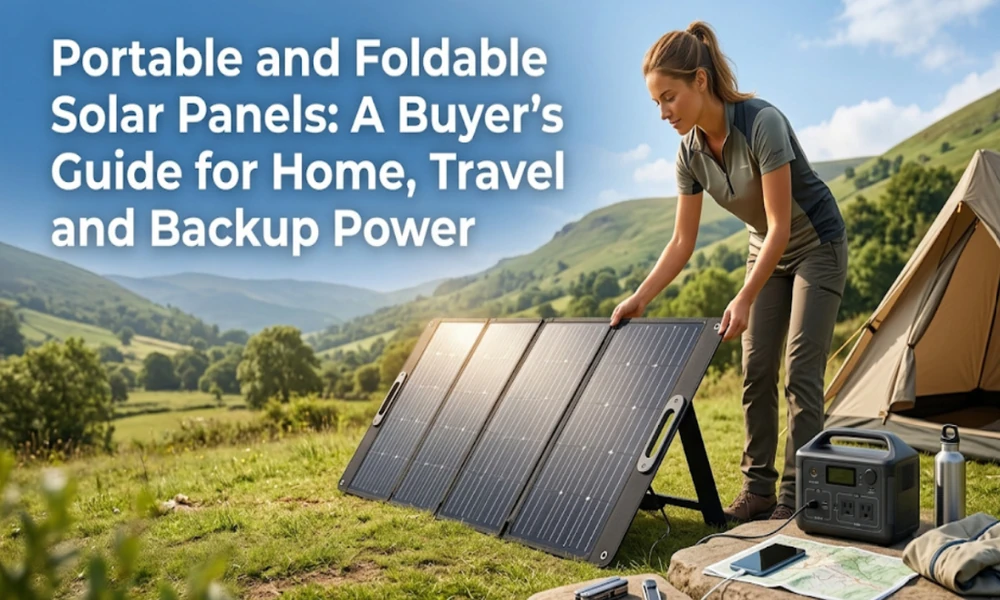
Just think about charging your smartphone while camping, using some devices on the go, or producing energy from a place that is not connected to the power grid. Foldable panels enable this possibility as they give people the opportunity to produce electricity without having to install any kind of fixed solar system.
However, there are many kinds of portable solar panels with various wattages, dimensions, and designs, making their choice quite problematic. It is therefore useful to have an understanding of these panels prior to purchasing one.
What Are Portable and Foldable Solar Panels?
The term “portable solar panel” indicates a panel that needs to be transported from one place to another as opposed to being fixed on top of your house’s roof permanently. These can also be foldable solar panels, which means they can fit in a small space.
They can be made of either traditional rigid panels or some light material. If the surface where you intend to install the panel is curved, flexible solar panels could also work for you.
Most portable units produce electricity during the day. This electricity will either be used directly to run your gadgets or stored in a battery. This would depend on your energy consumption and your gadgets.
Where can you utilize portable solar panels?
1. At home when there is no electricity
The portable solar panel is capable of charging a compatible energy storage unit such as a power station or a battery that will then enable you to have enough power to run your phone, lighting fixtures, internet router, and other small gadgets. Larger appliances require a bigger system.
2. Travelling and camping purposes
Portables will come in handy for those who do a lot of outdoor activities, as you will be able to place it in a sunny spot to charge your phone, camera, GPS, portable battery, and other electronics without having to depend on electric outlets.
3. Caravans, boats, RVs
Conventional panels can be quite bulky to carry around and install in the case of cars and boats. Portable panels will be useful in situations where weight and limited mounting surface are a priority. Flexible solar panels can be used in some cases for curved surfaces as well.
4. Remote workplace sites
Portable solar panel systems will come in handy for small electrical gadgets in places where grid electricity cannot be accessed.
What Should You Check Before Buying?
Choosing a panel based only on its price or appearance can lead to disappointment. A few practical checks can help you find one that suits your needs.
Power generation: Check the power ratings of the panel and then compare them with the needs of your devices. A smaller panel will work fine for charging a phone but not for a laptop or some other device.
Portability and weight: In case you intend to move the panel often, consider factors like its compactness, weight, handles, and setup time. A bigger panel may produce more electricity, but it would be difficult to move around with it.
Compatibility with batteries: If you want to use electricity even after the sun is down or on a cloudy day, you have to get an appropriate battery and portable power station. Make sure the panel, charge controller, battery, and all the connectors are compatible.
Resistance to weather: All outdoor equipment can suffer from dust, rain, heat, or changing weather conditions. Read about the specifications of the panels offered by the manufacturer and make sure to use them in their specified conditions.
Warranty and durability: Consider the warranty, performance guarantees, and maintenance recommendations of the panels. It is better to buy from reliable and well-known solar panel manufacturers.
Are Flexible Solar Panels Worth Considering?
Traditional glass panels work well for many permanent installations, but their weight and rigid structure can limit where they can be fitted. Flexible solar panels offer another option for applications where a lighter design or a curved mounting surface is important.
Waaree offers lightweight flexible solar modules designed for applications such as curved rooftops, vehicles, and portable systems. Their thin construction can make them useful where conventional panels are difficult to install. However, flexible modules are not automatically foldable, and not every model is designed to be repeatedly bent. Always follow the manufacturer’s mounting and handling instructions.
You can explore Waaree’s flexible solar panels to learn more about their specifications and potential applications.
How Much Power Are You Likely to Generate?
Generation of power varies from the panel’s rated wattage and the above-mentioned factors. A 100 watt panel does not have to generate 100 watts all day long.
For instance, if a 100 watt panel gets as much radiation as 5 peak sun hours, it can generate approximately 500 watt hours of power without considering any system losses. In some cases, the amount of usable power might be less after system losses.
Thus, it is necessary to assess your daily power consumption needs before purchasing a panel. Realistic estimation helps you to avoid both an insufficiently powered system and an excessively expensive one.
Conclusion
Portable and foldable solar panels can be useful for people who need electricity while travelling, working outdoors, or preparing for power cuts. The right choice depends on how much power you need, how often you will move the panel, and whether you need battery storage. With over 25.8 GW in manufacturing capacity, Waaree is an established PV solar module manufacturer offering solutions for different solar applications, including lightweight flexible modules. Exploring the available options can help you find a solar solution that fits your space, lifestyle, and energy requirements.