
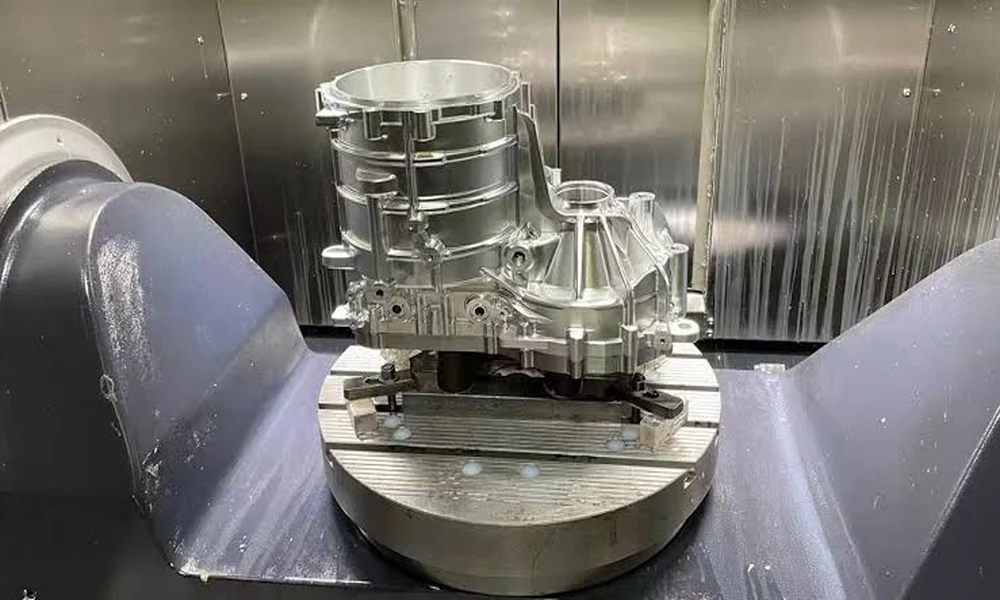
CNC machining (Computer Numerical Control Machining) is a revolutionary subtractive manufacturing technology that has transformed the industrial landscape. By integrating computer-guided control systems with high-precision machine tools, CNC machining enables the efficient production of complex, high-quality hardware with micro-level accuracy. This article explores the core concepts, core advantages, machine classifications, end-to-end workflows, and industry applications of CNC machining-alongside how global precision leaders like CS Rapid MFG deliver comprehensive machining solutions.
Core Concepts of CNC Machining
At its core, CNC machining is a subtractive process that uses pre-programmed computer software to dictate the motion of industrial cutting tools and machinery. Unlike manual machining-which relies heavily on manual handwheel adjustments and operator technique-CNC machining fully automates toolpaths and cutting parameters.
The primary programming language utilized is G-code (standardized ISO/EIA numerical control language). G-code provides detailed execution commands to the machine tool, defining linear/rotational coordinates, feed rates, spindle RPM, coolant flow, and tool change sequences.
A complete CNC machining ecosystem comprises three vital elements:
Machine Tool: The mechanical equipment responsible for physical material removal (e.g., CNC mills, lathes, grinders, or multi-axis machining centers).
Controller: The onboard computer module that parses G-code instructions and converts them into precise electrical impulses for servo or stepper motors.
Input & Connectivity Systems: The interface used to import compiled G-code files into the machine controller via network interfaces, direct CAD/CAM links, or external drives.
In a modern multi-axis CNC milling setup, tools move across multiple axes (X, Y, Z, A, B, C) simultaneously. Designers first create a 3D digital model using CAD (Computer-Aided Design) software, convert it into optimized toolpaths and G-code via CAM (Computer-Aided Manufacturing) software, and then transfer the code to the controller for automated execution.
Key Advantages of CNC Machining
1. High Precision and Micro-Tolerances
CNC machines consistently achieve tight dimensional tolerances-often within ±0.005 mm (or a few thousandths of an inch). This extreme precision is mandatory in mission-critical industries such as aerospace, medical devices, and defense.
2. Superior Repeatability and Quality Consistency
Once a machining program is compiled and verified, the machine can execute identical cutting cycles endlessly with virtually zero variance. This level of repeatability guarantees uniform component quality across prototype batches and volume production runs.
3. Accelerated Throughput and Lower Overhead
CNC machinery can run continuous 24/7 “lights-out” operations with minimal direct supervision. Automated bar feeders, tool changers, and pallet systems increase production speeds while drastically reducing labor expenses and project lead times.
4. Advanced Geometric Freedom
Multi-axis CNC equipment handles complex organic curves, undercuts, angled bores, and deep cavities that are technically impossible or cost-prohibitive to produce using manual machining.
Classifications of CNC Machinery
Modern CNC machining encompasses a wide range of specialized equipment, including:
CNC Milling Machines & Machining Centers: Utilize high-speed rotating cutters to remove material from a stationary or multi-indexed workpiece. Options include Vertical Machining Centers (VMC) for top-surface detailing and Horizontal Machining Centers (HMC) for multi-sided structural components.
CNC Lathes & Turning Centers: Rotate the workpiece against single-point cutting tools. Ideal for cylindrical components such as shafts, bushings, connectors, and threaded fittings. Live-tooling lathes integrate rotational tools to combine turning and milling in a single setup.
CNC Precision Grinders: Use abrasive grinding wheels for fine finishing operations, achieving ultra-smooth surface finishes and sub-micron dimensional accuracy for bearings, gears, and shafts.
CNC Laser & Waterjet Cutting Equipment: Employ high-powered laser beams or ultra-high-pressure abrasive water jets to profile flat sheet materials, sheet metal components, and intricate flat profiles with clean edges.
The Standard CNC Machining Process Workflow
The execution of a custom CNC machining project follows a structured engineering workflow:
CAD Modeling: An engineer creates a accurate 3D CAD model containing all part geometries, critical dimensions, draft angles, and thread specifications.
CAM Programming & DFM Review: The model is processed through CAM software to establish cutting strategies, select tooling, calculate feed/speed rates, and generate optimized G-code. A Design for Manufacturability (DFM) review is conducted to catch potential machining issues early.
Machine Setup & Calibration: The operator installs the required cutting tools, mounts raw stock into fixtures or chucks, and calibrates work coordinate systems using touch probes or optical setters.
Machining Execution: The CNC program runs under real-time controller monitoring to execute roughing, semi-finishing, and finishing passes.
Quality Inspection & Post-Processing: Finished components undergo dimensional inspection using Coordinate Measuring Machines (CMM), micrometers, and optical comparators. Surface finishing operations (such as anodizing, bead blasting, or passivation) are applied as specified.
Industry Applications & Complete Machining Services by CS Rapid MFG
CNC machining is an indispensable manufacturing method across virtually all modern technology industries:
Aerospace & Defense: Jet engine turbine blades, structural airframe fittings, avionics enclosures, and fuel system manifolds.
Automotive & Robotics: Cylinder heads, transmission housings, custom suspension links, and robotic manipulator joints.
Medical & Healthcare: Biocompatible titanium orthopedic implants, surgical scalpel handles, diagnostic housing assemblies, and custom dental prosthetics.
Electronics & Telecom: Aluminum heat sinks, custom laptop housings, RF shielding boxes, and fiber-optic connectors.
Consumer Products: High-end watch cases, custom audio equipment chassis, and ergonomic hardware.
Partner with CS Rapid MFG for Custom CNC Machining Solutions
Executing complex digital designs requires advanced multi-axis infrastructure, rigorous quality assurance, and specialized manufacturing expertise. CS Rapid MFG (CS Mold Co., Limited) is an ISO 9001:2015 certified global precision manufacturer specializing in high-precision CNC machining, rapid prototyping, sheet metal fabrication, plastic injection molding, and on-demand production services.
Operating out of an expansive facility equipped with over 80 high-precision CNC machines-including advanced Hermle and DUG 5-axis, 4-axis, and 3-axis CNC milling centers as well as high-precision CNC lathes-CS Rapid MFG delivers end-to-end manufacturing support:
- Comprehensive Machining Capabilities: Full coverage of precision CNC Milling, CNC Turning, Sheet Metal Fabrication, and Rapid Tooling under one roof.
- Engineering DFM & Fast Turnaround: Free Design for Manufacturability (DFM) feedback on every inquiry, with custom prototype parts manufactured and shipped in as fast as 3 to 5 days.
- Flexible Volume Options: No Minimum Order Quantity (NO MOQ)-supporting single prototype models up to thousands of end-use production parts with competitive global pricing.
- Guaranteed Precision & Quality Control: Adherence to strict ISO standards, complete material certification, CMM dimensional inspection, and advanced post-processing options.
To request a 12-hour instant quote or consult with project engineers on your next CNC machining project, visit the official platform at CS Rapid MFG.
Conclusion
CNC machining remains a core technology driving modern industrial innovation. Its unparalleled combination of micro-level precision, rapid throughput, repeatability, and material adaptability empowers manufacturers to bring complex concepts into physical reality. By leveraging the advanced multi-axis machining capabilities and global logistics of specialized manufacturing partners like CS Rapid MFG, organizations can streamline product development, reduce overall production costs, and maintain a competitive edge in today’s fast-paced market.