
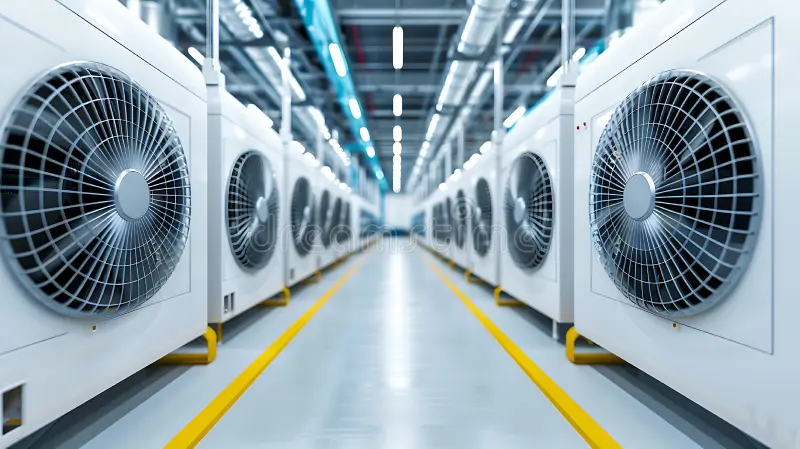
Heating and cooling are not often considered as strategic business priorities and tend to stay in the background until something goes wrong. By that time, the costs have escalated. For business owners in charge of a commercial building, this is the exact attitude to avoid.
Heating and cooling represent about 35% of total energy usage in a typical commercial building, meaning it’s the biggest energy cost businesses have to deal with. And that cost won’t go down by itself.
The Reactive Maintenance Trap
Many buildings are only equipped with a single chiller or boiler, meaning a wait of several days for a replacement if the unit’s irreparable. However, if a technician conducts a test and highlights potential failure points in a burner or compressor, these can often be renewed in minutes. The logic is simple: do you want to pay a standard hourly wage for a planned service, or a triple-time emergency rate to fix the same issue on a sweltering August long weekend?
Efficiency Starts At The Boiler, Not The Thermostat
Many buildings invest in improved insulation or updated windows and then wonder why their heating bills don’t change. Often, it’s because the heating system itself hasn’t been serviced or updated in many years.
While efficiency is not about simply throwing new equipment at the challenge, it is certain that a new boiler installation is a more attractive proposition when the other variable – the existing system’s performance – has been accurately summed.
Similarly, investing in modernized, precisely controlled performance from a new boiler is less appealing if the distribution system to which it’s connected requires regular manual balancing and oversized pumps to maintain an even temperature across all floors.
Here, also, the upgrade question becomes one influenced by maintenance: can new valve assemblies or networked controls make the system more responsive and less wasteful than it is today? This is where regional expertise matters more than it might seem. A Commercial Boiler and Burner Service Canberra team calibrating a burner to local conditions delivers better results than one applying a generic service checklist, ensuring your heating infrastructure is tuned to how the system actually operates in that environment.
Reading The Data Your System Is Already Producing
Most mid-sized to large commercial structures are now equipped with building automation systems. These systems monitor and collect hundreds if not thousands of performance data points – including cycle time. However, most facility managers only look at the data reactively – when they think there is a problem.
Short-cycling is one of the most obvious early warning signs captured in system data. It describes a piece of equipment that is turning on and off more often than needed. You can tell because it never completes a full cycle and heats or cools the air that was just air conditioned or heated moments earlier.
The implications range from the equipment being oversized in the first-place (predominantly a design flaw) to cooking off the refrigerant within a year or two on replacement equipment (predominantly a maintenance and commissioning flaw.) Other common causes include pressure issues caused by a faulty economizer or leaks on the low or high-pressure side of the refrigeration system.
Short-cycling is bad because it wears out those expensive components much faster than they should be. New smart starters and controllers abound that can log this and other invaluable information giving a good technician a chance to diagnose a problem before it becomes a catastrophic failure. If you are not at least quarterly reviewing the cycle data of your equipment, you are flying blind on your biggest maintenance and energy cost.
Zoning, Redundancy, and Avoiding Unnecessary Load
Two aspects of building climate that often are forgotten are zoning on the thermostats and redundancy in the equipment.
Thermostat zoning divides the building into areas with their own thermostat control, meaning you aren’t heating a full-capacity boardroom while it’s been unoccupied for six hours. The concept isn’t new. The implementation challenge is that it costs real money today, while the return on investment is hypothetical energy savings into the future.
Redundancy planning is something that smaller buildings and operations can skip unless the business is essentially dead in the water without climate control (e.g. cold storage, medical practices, and many manufacturing processes). Having a dual burner or modular unit as a backup isn’t over-engineering a solution – it’s buying insurance with a known cost against a disaster with an unknown cost.
Treating The System As An Asset, Not A Utility
Changing the way in which facility management responds to issues and becoming more proactive boils down to redefining what most people think HVAC is. It not just a background system that happens to function or not. It represents a capital investment that has a lifespan, a performance curve, and measurable consequences on your operation costs, staff turnover, and occupant satisfaction.
An energy audit provides you with that cornerstone. It shows you where your consumption is going and where the worst of the waste is occurring. A revamped maintenance window, a burner calibration tune-up, and a zoning realignment will highlight the low-hanging fruit and set you up for the necessary longer-term capital planning.
Building owners that do this properly don’t spend more on their buildings. They just spend more intentionally and stop eating costs they didn’t realize they could push back on.