
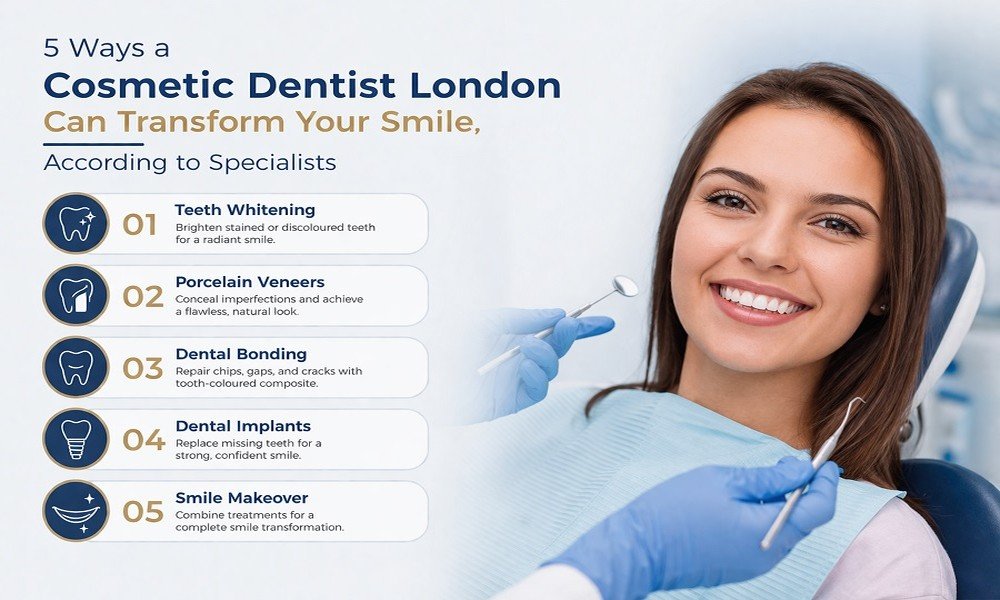
A better smile is rarely about looks alone. What often patients is that the biggest change is not always the whitest teeth or the most dramatic before-and-after result. It is the shift from noticing your teeth all the time to forgetting about them and simply getting on with your day. That is where a well-planned cosmetic approach can make a real difference. A skilled cosmetic dentist London patients trust will usually focus on proportion, comfort, function, and long-term maintenance as much as appearance, because a smile that looks good but feels unnatural is unlikely to satisfy anyone for long.
A cosmetic dentist from MaryleboneSmileClinic in London advises that the best aesthetic results usually come from careful planning rather than rushing into one fashionable treatment. In their view, patients should look for a cosmetic dentist London residents can consult for an assessment that considers facial features, bite, tooth health, and long-term maintenance before any visible changes are made. That measured approach matters because veneers, bonding, whitening, aligners, and contouring all suit different clinical situations, and the right treatment is often the one that preserves the most healthy tooth structure while still producing a natural result.
Reshaping First Impressions Without Chasing Perfection
One of the most important ways cosmetic dentistry changes a smile is by improving overall balance rather than creating a uniform, artificial finish. People often focus on one detail, such as a chipped front tooth or uneven edges, but specialists usually assess the whole smile in context. They look at tooth width, gum display, the way the upper teeth follow the curve of the lower lip, and whether one side of the smile appears heavier or flatter than the other. Small adjustments in these areas can produce a result that looks strikingly different without appearing obvious. In many cases, the goal is not for other people to notice dental work. The goal is for them to notice that the person looks healthier, more relaxed, or more confident.
This is particularly relevant in London, where working life can place unusual emphasis on presentation. Client-facing roles, media work, hospitality, law, recruitment, and senior corporate positions can all heighten awareness of appearance, especially when video calls and professional photography are routine. Yet the strongest cosmetic outcomes are usually the most restrained. A patient may need only edge bonding, enamel recontouring, or whitening rather than a full set of veneers. When treatment is selective, the smile often looks more believable and ages more naturally. It also tends to be easier to maintain. Specialists frequently stress that cosmetic success is not measured by how much dentistry has been done, but by whether the treatment solves the problem that bothered the patient in the first place.
Correcting Colour in a Way That Still Looks Natural
Tooth colour is often the first concern patients mention, but colour correction is more complex than simply making teeth whiter. Teeth reflect light in subtle ways, and natural smiles usually contain variation in tone, translucency, and surface texture. Overly bright or uniformly opaque results can stand out for the wrong reasons. That is why modern cosmetic treatment tends to involve shade planning rather than a blanket approach. Whitening may be enough for mild discolouration caused by tea, coffee, red wine, or smoking, but internal staining, old restorations, or enamel wear may call for bonding, veneers, or crowns in selected areas. The challenge is to create brightness that still fits the patient’s age, complexion, and existing dental anatomy.
Another factor is contrast. Teeth can appear dull not only because they are dark, but because surrounding issues such as crowded edges, stained fillings, or uneven gums make the whole smile look tired. Addressing those details can enhance colour even before the final shade is chosen. Patients often assume cosmetic dentistry is mainly about dramatic transformation, yet much of the work lies in careful matching. The most convincing smiles are not always the whitest in the room. They are the ones that sit comfortably within the face. A thoughtful cosmetic dentist London patients consult for aesthetic care will usually explain the limits of whitening, the lifespan of different materials, and the reasons some shades look polished in photographs but less natural in daylight.
Repairing Shape, Chips, and Wear With Minimal Intervention
Many smile concerns begin with gradual wear rather than sudden damage. Years of grinding, acidic drinks, nail biting, or natural enamel thinning can shorten teeth, flatten edges, and make the smile look older or less defined. Small chips and irregular contours can also draw attention because the front teeth are so visible when speaking. One of the most useful developments in cosmetic dentistry has been the ability to correct these issues with conservative treatment. Composite bonding, for example, can often rebuild corners, close minor gaps, and refine outlines with minimal or no drilling. In the right case, it offers a practical route to a fresher smile without the commitment of more extensive intervention.
That conservative approach matters because preserving healthy tooth tissue is a central principle of modern dentistry. Not every patient needs porcelain veneers, and not every tooth should be prepared simply for the sake of symmetry. In many situations, the smartest treatment is the least invasive one that delivers a stable and attractive result. For someone with edge wear and slight asymmetry, a combination of bite assessment, night-guard advice, and carefully placed bonding may be enough to change the whole look of the smile. These treatments can also be staged, allowing patients to improve their appearance gradually rather than committing to a major makeover all at once. When expectations are realistic, even modest reshaping can have a strong visual impact.
Straightening Teeth as Part of a Wider Smile Plan
Straightening is often seen as a separate category from cosmetic dentistry, but in practice it is one of the most effective aesthetic tools available. Teeth that overlap, twist, or sit too far forward can make a smile appear darker, less even, or harder to clean. Orthodontic treatment, including clear aligners in appropriate cases, can improve not only alignment but also the way light reflects across the teeth. Once the teeth are in better positions, other cosmetic work may become simpler, more conservative, or even unnecessary. A patient who initially expects veneers on several front teeth may discover that alignment plus whitening gives a better and more natural result.
There is also a functional side to this transformation. Better positioning can improve brushing access, reduce plaque retention around crowded areas, and limit uneven wear caused by poor contact patterns. That matters because cosmetic dentistry works best when it supports oral health rather than ignoring it. London patients are often looking for efficient treatment plans, especially if they are balancing work, commuting, and family responsibilities. For that reason, integrated planning is essential. Straightening should not be sold as a quick visual fix if there are deeper bite issues to consider. Equally, patients should not be pushed towards restorative treatment when tooth movement could solve the underlying problem more elegantly. The strongest treatment plans are those that sequence each step logically and avoid unnecessary dentistry.
Replacing Missing Teeth and Restoring Confidence in Daily Life
A missing tooth changes more than a smile. It can affect speech, chewing confidence, and the way a person carries their mouth in conversation. Some people begin smiling with their lips closed or turning their head slightly in photographs. Others avoid certain foods or become anxious about visible gaps in professional settings. Replacing missing teeth therefore has both cosmetic and practical value. Depending on the case, the options may include implants, bridges, or carefully designed removable solutions. The cosmetic element lies not only in filling the space, but in matching shape, gum line, emergence profile, and neighbouring tooth colour so that the replacement blends in naturally.
This area of dentistry highlights why specialist assessment is so important. Replacing a front tooth, in particular, is rarely just about putting something white in the gap. Bone levels, gum tissue, bite forces, smile line, and the condition of adjacent teeth all influence the final result. In some patients, orthodontics or gum treatment may be needed before replacement begins. In others, the best aesthetic outcome comes from preserving neighbouring teeth rather than preparing them. A reputable cosmetic dentist London patients see for this kind of work should explain the biological and visual trade-offs clearly. People often focus on the restoration itself, but specialists know that the surrounding tissues are what make the result believable. When those details are handled well, patients often report that they stop thinking about the gap entirely.
Choosing the Right Treatment in a City Full of Options
London offers an enormous range of dental providers, which can be useful but also confusing. Patients are often faced with polished websites, dramatic images, and heavily marketed claims before they understand the basics of what they actually need. The most sensible starting point is not a trend or a package, but a diagnosis. Before deciding on veneers, bonding, whitening, aligners, or implants, patients should know whether they have active gum disease, decay, grinding, jaw tension, or unstable bite patterns. Cosmetic treatment placed on an unhealthy foundation is likely to disappoint, however attractive it looks at first. Good clinicians therefore tend to ask practical questions: what bothers you, what do you want to preserve, how much maintenance feels realistic, and what will matter to you five or ten years from now.
That practical mindset helps separate cosmetic dentistry from cosmetic salesmanship. The best treatment plan may be more modest than the patient expected, or it may involve phases spread over time. Either way, the aim should be durability, comfort, and appearance working together. A smile can be transformed through whitening, reshaping, alignment, replacement, or subtle restoration, but the most successful changes are usually the ones that respect the patient’s existing anatomy and daily habits. Cosmetic dentistry in London is at its strongest when it is not trying to manufacture perfection. It is trying to remove distractions, rebuild confidence, and create a smile that makes sense on the face it belongs to.