
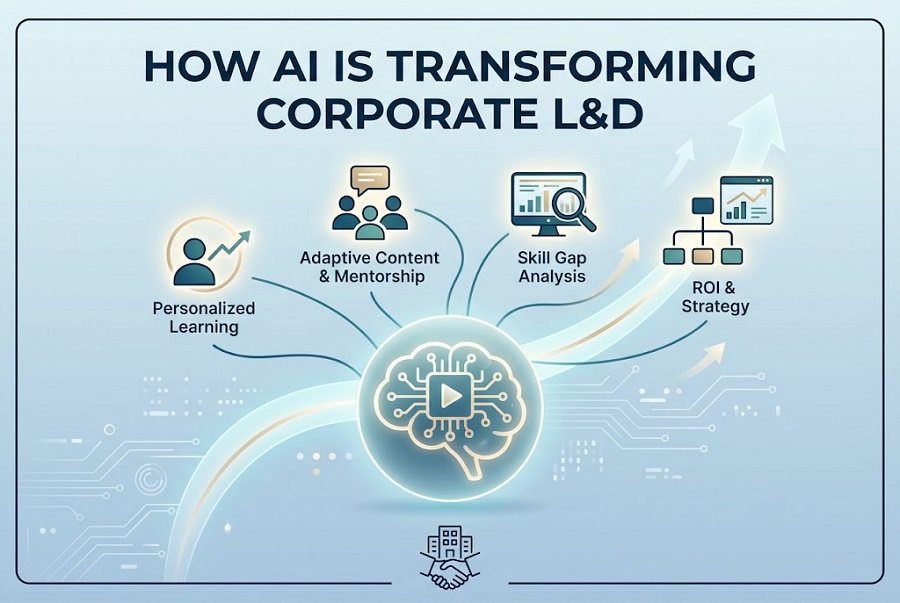
Artificial intelligence is reshaping corporate learning and development faster than any prior wave of technology. What began as modest experiments — recommendation engines tucked inside learning platforms or simple chatbots that answered policy questions—has matured into a suite of capabilities that can personalise learning at scale, automate content creation, and connect learning to measurable business outcomes. For employee training and development, the question is no longer whether AI will influence the learning function, but how to harness it safely, ethically, and strategically to build skills and performance in line with organisational priorities.
Below, we explore the most significant ways AI is transforming L&D today, the practical use cases delivering value, the pitfalls to avoid, and a pragmatic roadmap to get started.
1) Personalised learning at scale
Historically, personalisation has been the privilege of small cohorts and specialist programmes. AI changes the equation. By analysing learner behaviour, skill inventories, performance data, and role requirements, AI systems can assemble learning paths that adapt in real time:
- Dynamic pathways: As learners demonstrate mastery (via knowledge checks or on-the-job proxies), AI adjusts the path—skipping redundant modules and suggesting stretch activities when appropriate.
- Content routing: AI models match content difficulty to learner readiness, reducing drop-off that occurs when material is too easy or too hard.
- Moment-of-need support: Context-aware assistants surface micro-learning in the flow of work—tip sheets, policy summaries, or short videos relevant to the task at hand.
The impact is twofold: learners gain relevance and momentum, while organisations see better utilisation of learning assets and clearer links to performance. Personalisation also helps L&D move beyond “course-first” thinking to “skill-first” orchestration, using AI to recommend the best mix of modalities—coaching, practice, shadowing, simulations, and formal instruction.
2) AI-assisted content creation and curation
Quality content remains the bedrock of effective learning. Yet traditional development cycles can be slow and expensive. AI accelerates production without sacrificing rigour:
- Drafting and localisation: Generative models can produce initial drafts of lesson plans, facilitator guides, scenarios, and assessments, which SMEs then refine. Translation and localisation workflows are similarly accelerated, making global rollout more consistent.
- Variant generation: Need multiple versions of an assessment keyed to different difficulty levels or roles? AI can programmatically create variations while maintaining alignment to the same learning objectives.
- Metadata enrichment and tagging: AI automates the tagging of content with skills, competencies, and use cases, improving discoverability and targeted recommendations across learning libraries.
Two guardrails are essential: human review (to ensure accuracy, tone, and relevance) and disciplined source attribution (so learners can trust material and revisit original references where needed). When combined with editorial standards and governance, AI lets L&D teams scale high-quality content while re-allocating human effort towards the advanced instructional design and authentic practice experiences that AI cannot fully replicate.
3) Assessment, feedback, and practice—made smarter
Assessment is not merely about scores—it’s about feedback loops that build competence. AI strengthens those loops:
- Adaptive assessment: Item difficulty adjusts based on responses, giving a more precise gauge of proficiency in fewer questions and reducing test fatigue.
- Automated feedback: AI can provide immediate, formative feedback on written submissions, role-play transcripts, and simulation outputs, highlighting strengths and offering specific improvement actions.
- Simulation and scenario design: AI can create realistic customer dialogues, incident reports, or case studies with variable conditions, enabling safe practice for sales, service, compliance, and leadership behaviours.
This approach promotes “assessment as learning”, helping individuals see pathways to improvement and practice deliberately. For L&D analytics, the richness of AI-generated data (response patterns, common misconceptions, time-on-task) offers deeper insights into where curricula succeed and where they need rework.
4) Skills intelligence and workforce planning
The shift towards skills-based organisations depends on clarity: which skills do we have, which do we need, and how do we develop, deploy, and reward them? AI-powered skills graphs provide that clarity by mapping roles to skill clusters and connecting learning pathways to career mobility:
- Inference and validation: AI infers skills from CVs, performance data, project histories, and learning records, while validation comes from manager endorsements, practical assessments, and observed outcomes.
- Gap analysis: Visual dashboards reveal skills supply versus demand across teams, functions, and geographies.
- Targeted interventions: L&D can prioritise programmes based on high-impact gaps tied to strategic goals, ensuring learning investments drive measurable value.
The result is tighter integration between learning, talent acquisition, performance management, and workforce planning. For employees, it creates transparent, equitable pathways to opportunity, underpinned by evidence rather than tenure alone.
5) Learning in the flow of work
One of the strongest predictors of transfer is proximity: the closer learning is to real work, the better the uptake. AI enables true “flow of work” experiences:
- Contextual assistants: Embedded AI companions in productivity tools surface relevant guidance, templates, and examples as employees write, analyse, or present.
- Task-aware micro-learning: Short, just-in-time lessons triggered by the activity—preparing for a client pitch, editing a policy, coding a function—keep learning tightly coupled with application.
- Knowledge mining: AI scans documents, chats, and recordings (with proper consent and governance) to extract reusable knowledge artefacts, turning tacit know-how into searchable assets.
This approach reduces friction: learners don’t need to leave their workflow to find learning; learning comes to them.
6) Culture, ethics, and change management
AI adoption is not just a technology deployment—it is a culture shift. Trust, transparency, and inclusion are vital:
- Explainability and consent: Learners should know how recommendations are made, what data is used, and how they can control their preferences. Clear consent models and opt-out mechanisms build confidence.
- Bias mitigation: Diverse training sets, fairness testing, and human oversight reduce the risk of perpetuating inequities. L&D should partner with legal, DEI, and data teams to define standards and review cycles.
- Role of the human: AI augments, not replaces, facilitators and mentors. Human connection is central to motivation, psychological safety, and nuanced feedback—especially in leadership, communication, and ethical judgement.
Change management matters: communication plans, pilot groups, feedback channels, and visible sponsorship accelerate adoption and help surface issues early.
7) Measuring impact: from activity to outcomes
AI improves measurement by linking learning data to operational metrics:
- Unified learning records: Learning Experience Platforms (LXPs) and Learning Record Stores (LRS) consolidate data across formal courses, micro-learning, coaching, and experiential assignments.
- Outcome alignment: AI models can correlate learning activity with downstream outcomes—sales cycle time, quality defects, customer satisfaction, project velocity—while respecting privacy and avoiding spurious causation.
- Signal-driven iteration: When performance shifts, L&D can quickly adjust the learning mix, retiring low-impact assets and doubling down on the experiences that drive progress.
The goal is to move beyond vanity metrics (enrolments, completions) towards evidence of skill acquisition and performance change. This strengthens L&D’s credibility with finance, operations, and the executive team.
8) Practical use cases delivering value now
While the vision is broad, several use cases have proven reliable and high-ROI:
- Sales enablement: AI-generated role-play scenarios, call analysis with coaching prompts, and adaptive product knowledge assessments shorten ramp time and improve win rates.
- Customer service: Real-time assistants suggest compliant responses and relevant knowledge articles, while AI flags training needs (e.g., empathy, tone, policy changes) based on conversation analytics.
- Compliance and risk: Adaptive micro-learning keeps employees current with regulatory shifts; scenario-based simulations test judgement in complex, grey-area situations.
- Leadership development: AI aids reflection (journals, 360 feedback synthesis), suggests practice challenges, and augments coaching with insights from meeting transcripts (with consent and appropriate governance).
- Technical upskilling: Coding copilots, sandbox feedback, and automated code review help developers practice and learn faster, backed by curated learning paths mapped to technology stacks.
9) Common pitfalls (and how to avoid them)
AI can misfire if adoption is rushed or under-governed. Avoid these traps:
- “Tech-first” deployment: Define the business problem before choosing tools. Let desired outcomes drive solution selection.
- Underestimating human review: Generative content can be plausible but wrong. Introduce editorial gates, SME sign-off, and citation requirements.
- Over-automation of assessment: Maintain a balance between automated feedback and human coaching, especially for behavioural skills.
- Data sprawl and privacy risks: Consolidate learning data, minimise what is collected, employ robust access controls, and maintain data retention policies aligned with regulation.
- Ignoring faculty development: Facilitators and mentors need their own AI upskilling—how to design AI-enabled learning, interpret analytics, and coach alongside digital tools.
10) A pragmatic roadmap for L&D leaders
To build momentum without overreaching, consider this staged approach:
Stage 1: Foundation
- Audit current learning assets, platforms, data flows, and governance.
- Establish AI principles (transparency, equity, privacy, safety) and cross-functional oversight.
- Identify 2–3 high-value use cases tied to pressing business outcomes.
Stage 2: Pilot
- Run controlled pilots with clear success criteria (e.g., reduced time-to-proficiency, improved customer satisfaction, lower error rates).
- Invite learners and managers to co-design—feedback loops will surface practical constraints and adoption friction.
- Document workflows, risk controls, and editorial standards for content and assessment.
Stage 3: Scale
- Integrate AI capabilities with core systems (HRIS, LXP/LMS, productivity tools) to enable flow-of-work experiences and unified analytics.
- Build skills taxonomies and competency frameworks that connect learning to talent mobility.
- Introduce faculty enablement programmes—teaching facilitators how to collaborate with AI.
Stage 4: Optimise
- Use outcome-linked dashboards to continuously refine content, pathways, and practices.
- Rotate pilots across functions to spread adoption and diversify impact.
- Regularly review ethical guardrails and update policies as models and regulations evolve.
11) The human advantage in an AI-enabled L&D world
AI is powerful, but it does not replace the essence of learning: curiosity, reflection, community, and practice. The most effective programmes blend AI’s strengths—scale, speed, and personalisation—with human elements—real stories, peer learning, mentoring, and psychologically safe spaces to experiment. When L&D keeps humans at the centre, AI becomes a catalyst for capability, not a substitute for it.
It’s also worth recognising the broader impact: AI nudges organisations towards continuous learning cultures. As colleagues see learning genuinely improving performance and opening career paths, engagement rises. Leaders who role-model learning—using AI assistants openly, sharing insights from data, experimenting with new approaches—make it safe and aspirational for teams to follow.
12) Final thought: build for outcomes, earn trust, move fast
The promise of AI in L&D is compelling: personalised learning for everyone, measurable skills growth, and learning in the flow of work. Realising that promise depends on three commitments:
- Relentless focus on outcomes: Tie initiatives to business metrics that matter.
- Trust by design: Embed transparency, consent, and fairness from the start.
- Agile execution: Pilot, learn, and scale—avoiding perfectionism that slows momentum.
With these in place, AI becomes not just another tool in the L&D toolkit, but a strategic capability that helps organisations adapt, compete, and thrive in employee training and development.