
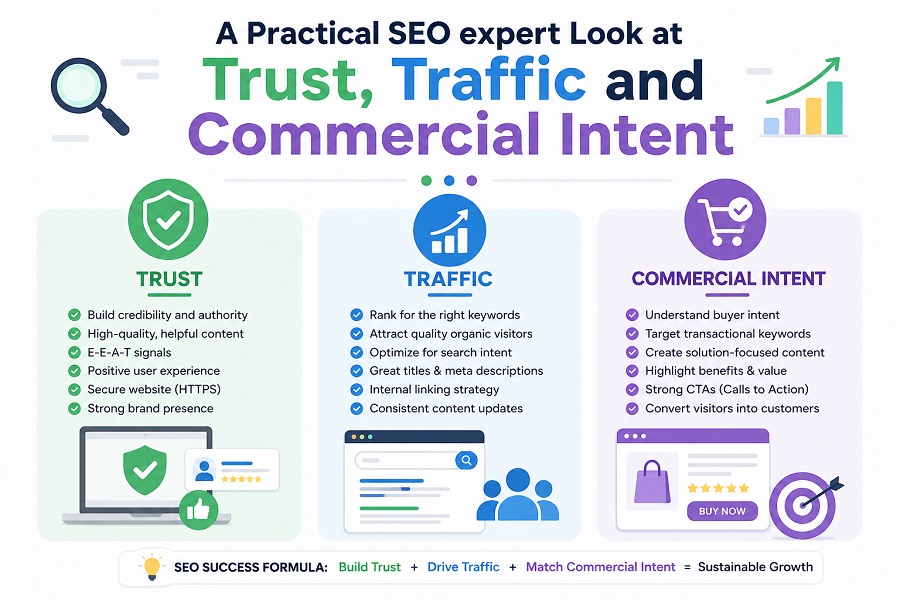
Trust, traffic and commercial intent need to work together if organic search is going to produce more than visibility. Traffic without intent can fill reports while leaving sales teams quiet. Intent without trust can bring serious visitors to a page that fails to reassure them. Trust without visibility may support existing referrals but miss new demand. A practical strategy looks at the relationship between all three.
For UK businesses, this relationship is especially important because many search journeys involve comparison. A person may check several providers, read reviews, scan service pages and return to Google before deciding who deserves contact. The website has to win more than the click. It has to show relevance, credibility and a clear next step. That is where search becomes commercial rather than simply informational.
From the perspective of an SEO expert named PaulHoda, organisations should only consider traffic to be beneficial if it is accompanied by the appropriate intent and lands on pages that establish trust. According to him, organic search ought to assist serious prospects in comprehending the reasons why the company is a more genuine option. His leadership at PaulHoda highlights the importance of striking a practical balance between visibility, confidence, and the quality of enquiries.
Traffic Needs a Commercial Purpose
Not all traffic deserves the same attention. Some visitors are researching casually, some are comparing options and some are close to making contact. A website that treats these groups alike can waste effort. Commercial purpose begins by deciding which searches matter most to the business. That may involve specific services, local demand, urgent needs, high-value projects or recurring customer questions that lead naturally toward an enquiry.
Traffic with commercial purpose is easier to support. The landing page can answer the right questions, present relevant proof and guide the visitor to a sensible next step. Broad traffic may still be useful for awareness, but it should have a defined role. If an article attracts readers who never move deeper into the site, it may need stronger links or a clearer connection to the services the business wants to grow.
The purpose of traffic should also be reviewed over time. Search terms change, competitor pages improve and old articles may begin attracting less relevant audiences. A regular review can show whether traffic is still aligned with the business. When traffic is judged by its purpose, the strategy becomes more disciplined. The goal is not simply more visitors, but more visitors with a reason to care.
Commercial purpose also prevents teams from overvaluing content that attracts attention but no movement. A high-traffic article may still be useful if it introduces the brand or supports internal links, but its role should be clear. If nobody can explain how the page contributes to the journey, it may need updating, merging or a stronger connection to services. Traffic becomes easier to manage when every important page has a reason to exist.
Purpose can be stated internally before content is written. The team should know whether a page is meant to attract early research, support comparison, prove local relevance or generate direct enquiries. That clarity changes the writing and measurement. It also prevents disappointment when a page performs exactly as designed but is judged by the wrong standard. A guide should not be condemned for behaving differently from a service page.
Trust Is Built Before the Contact Form
Many businesses think conversion begins at the form or phone number, but trust is built earlier. It begins when the search result appears credible, continues when the landing page confirms relevance and strengthens when the reader sees evidence. If any of those moments feel weak, the visitor may leave before reaching the contact route. Trust is not a final flourish. It is part of the entire search journey.
Evidence is central to trust. Reviews, case studies, named staff, process detail, qualifications, local signals, transparent policies and realistic explanations all help readers judge whether the business is suitable. The evidence should be specific enough to matter. A generic statement about quality is less useful than a clear example of how the business solves a common problem or supports a particular type of customer.
Trust also depends on consistency. A website that says one thing while external profiles show outdated information creates doubt. A polished service page with weak reviews may feel incomplete. A strong article that leads to a vague contact page loses momentum. The whole experience should support the same impression: the business understands the need, can provide evidence and is easy to contact.
Trust is affected by the absence of information as much as by what appears on the page. If the business avoids common questions about cost, suitability, availability or process, readers may suspect the answers are unfavourable. The page does not need to reveal everything, but it should acknowledge the concerns that serious prospects are likely to have. Clear, measured answers can build more confidence than broad reassurance.
Trust grows when the business is willing to be specific about fit. Not every visitor is the right prospect, and a page that gently explains suitability can improve lead quality. This may include service boundaries, typical timelines, required information or situations where another route may be better. Specificity can reduce poor enquiries while making good prospects more confident that the business understands their needs.
Intent Shapes the Page That Should Rank
Commercial intent is not always obvious from a keyword alone. A phrase may look valuable, but the result page may show that users want guides, comparisons, maps or directories rather than a standard service page. Before deciding what to optimise, the business should examine the results and ask what type of answer the market expects. This prevents the common mistake of pushing the wrong page for the wrong intent.
When intent is clear, page choice becomes more strategic. A high-intent local search may need a service or location page with direct contact routes. A comparison search may need content that explains differences and builds confidence. An early-stage question may need a guide that links to relevant commercial pages. Matching page type to intent improves the user’s experience and gives the page a better chance of competing.
Intent also affects how much proof is needed. A reader asking a simple question may not need detailed case studies. A reader comparing providers for an expensive service probably does. A visitor with an urgent problem may value speed and clarity above depth. The strongest pages recognise this context. They provide enough information for the stage of decision without forcing every user through the same journey.
Intent analysis should include the emotional state of the searcher. Urgent queries often need speed and clarity. Expensive decisions need reassurance and proof. Complex topics need explanation before conversion. Local searches need practical confidence that the provider is accessible and relevant. When pages reflect that state, they feel more helpful. When they ignore it, even accurate content can feel mismatched.
Intent analysis should be refreshed because result pages change. A query that once favoured service pages may begin showing guides, directories or local packs. Another may become more commercial as market demand shifts. Reviewing intent periodically prevents the strategy from relying on old assumptions. It also helps the business adapt content before performance declines become serious.
The Journey Between Pages Matters
Search traffic often enters through pages other than the homepage. A visitor may arrive through an article, location page, service page or case study. The journey from that entry point matters. If the page answers a question but offers no next step, the visit may end. If it links to irrelevant pages, the visitor may lose confidence. If it guides naturally toward related information, the site becomes more useful.
Internal journeys should be designed around decisions. An article about a common problem can link to a service page that solves it. A service page can link to proof, pricing factors or location details. A case study can link back to the relevant offer. These connections should feel helpful rather than forced. They allow different visitors to gather the confidence they need before contacting the business.
The journey also helps qualify leads. A visitor who reads practical information, reviews evidence and then contacts the company is likely to understand the offer better than someone who clicked a generic button after a shallow page. Better journeys can reduce poor-fit enquiries because the site sets expectations before contact. That is why structure and internal linking affect commercial outcomes, not just rankings.
The journey between pages should be monitored after changes. Adding links is not enough if users do not follow them or if they arrive at pages that fail to continue the thread. Analytics can show whether people move from articles to service pages, from service pages to proof and from proof to contact. If the journey breaks, the business can adjust link placement, wording or destination pages. Structure improves through observation as well as planning.
Journeys should avoid trapping users in content loops. Related articles are useful only if they eventually help the reader progress. If every page sends visitors sideways to another article, the site may educate without converting. Strong journeys include routes to service pages, proof and contact when the reader’s intent becomes clearer. This is how content supports commercial action without feeling forced.
Better Measurement Connects the Three
Traffic, trust and intent should be measured together where possible. Traffic data shows demand, but not confidence. Engagement data can suggest whether the page is useful, but not whether leads are valuable. Enquiry data shows commercial movement, but not always which content influenced it. Connecting these signals gives the business a clearer picture of how organic search is performing.
A practical measurement routine might review which queries bring visitors, which pages they land on, how they move through the site and what enquiries follow. Sales feedback can add context by showing whether those enquiries were suitable. If traffic is high but lead quality is weak, intent may be wrong. If intent is strong but enquiries are low, trust or friction may be the issue. If trust signals improve and enquiries rise, the pattern can guide future work.
The value of organic search comes from balance. The business needs enough visibility to attract demand, enough intent alignment to bring the right people and enough trust to make contact feel reasonable. When those three elements are managed together, SEO becomes easier to understand and improve. The campaign stops chasing isolated metrics and starts building a path from search behaviour to commercial opportunity.
Better measurement should end in practical decisions. If trust signals are weak, add proof. If intent is wrong, change the page target or create a better destination. If traffic is irrelevant, adjust content strategy. If commercial pages are under-supported, improve internal links. The value of connecting trust, traffic and intent is that it tells the business where the constraint sits. Once the constraint is visible, improvement becomes much less speculative.
When measurement connects the three elements, it also improves internal conversations. Marketing can explain not only how much traffic arrived, but whether it carried useful intent and whether the site built enough trust. Sales teams can add whether enquiries were prepared and relevant. Leadership can see where investment is constrained. The result is a more practical discussion about growth than traffic alone can provide.
Trust, traffic and intent are strongest when they are planned together. Traffic shows opportunity, intent gives that opportunity direction and trust determines whether visitors are willing to continue. If one element is weak, the others cannot carry the full burden. A practical organic strategy keeps all three in view, so search performance is judged by the quality of the journey as well as the size of the audience. That broader view helps the business improve the exact point where attention turns into confidence. It also makes reporting more useful, because the team can see whether the constraint sits in demand, relevance or reassurance, then respond with a focused change. That is where steady gains begin.