
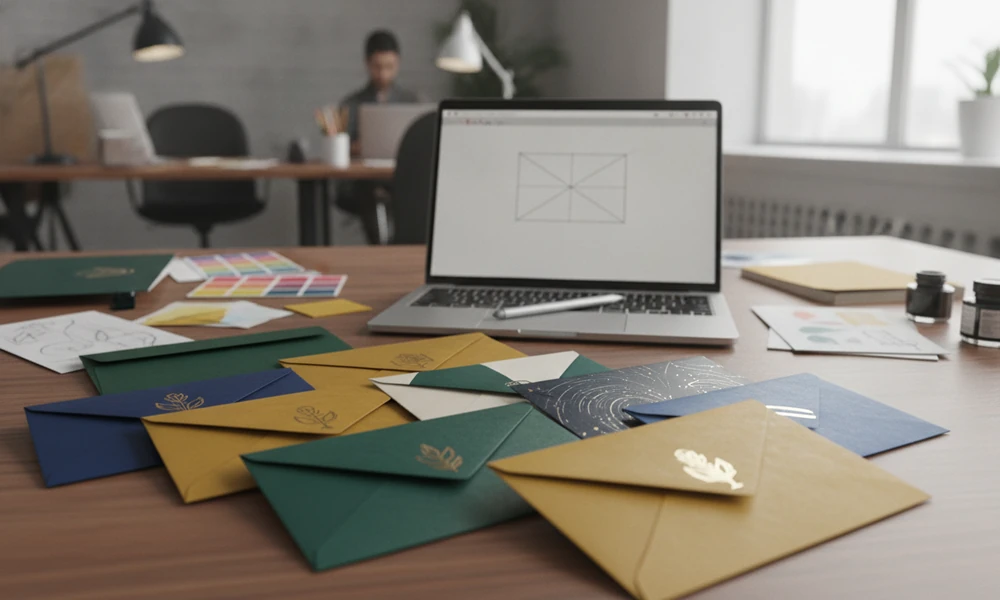
Tag – custom envelopes
In direct mail marketing, the envelope is key. It’s like an email subject line, setting the tone in seconds. If it looks good, more people will open it and read on.
Custom envelopes are more than just a logo. They can have bold colors, clear fonts, and teaser lines. They also have special finishes and variable data to make them stand out without being too flashy.
This guide is all about custom envelopes for direct mail in the U.S. It talks about the importance of trust and how to match your envelope to your campaign goals. You’ll find practical options for envelope printing in the USA.
Customization can really boost your results, as you’ll see in Section 2. Then, Section 3 will guide you on how to design and test your envelopes. Section 4 will show you how to put these ideas into action.
These strategies work in real U.S. scenarios, like retail promotions and healthcare reminders. If your envelope grabs attention, your message has a better chance of being seen.
Why Custom Envelopes Improve Direct Mail Marketing Performance
Mail is judged quickly. People decide in seconds if it looks useful or safe. This moment can shape your campaign’s success.
Custom envelopes help control this moment. They can make your mail look timely and relevant. This can lead to better responses from the start.
How envelope design influences open rates and first impressions
Good envelope design guides the eye. Color, contrast, and typography make the sender clear. Small details like window placement and teaser lines can signal importance.
Design should fit the message. A bold look can grab attention, but too much salesiness can cause doubt. Match the design to the message type for better results.
Brand consistency and recognition in the mailbox
Consistent branding makes you recognizable faster. This is key in multi-touch campaigns. Branded direct mail is easier to process because the sender is clear.
Consistency is also important inside the package. When the envelope, letter, and insert match, the experience feels connected.
Building trust and legitimacy with professional-looking mail pieces
Quality shows care and competence. Crisp print, accurate alignment, and readable addressing build trust. Sturdy paper stock can also change perception.
In industries like banking and healthcare, these details matter. A clear return address and recognizable brand marks help avoid being seen as junk mail.
When custom envelopes outperform plain or generic envelopes
Customization shines when stakes are high. For campaigns like acquisition pushes and event invitations, custom envelopes can grab attention. They help your piece stand out before it’s even read.
Plain envelopes can still be strategic for certain messages. Even then, custom envelopes can be subtle. Think refined logo, minimal ink, and premium stock for a discreet yet on-brand feel.
| Campaign situation | Envelope approach | Why it helps performance |
|---|---|---|
| New customer acquisition | High-contrast color accents, clear logo, short teaser | Stands out in a full stack of mail and clarifies the sender fast |
| Renewals and reactivation | Brand-forward, clean layout, readable window placement | Leans on familiarity, which can improve direct mail open rates over time |
| Event invitations | Premium stock, minimal design, strong hierarchy | Signals importance and increases perceived value before opening |
| Regulated or sensitive communications | Subtle branding, restrained color, clear return address | Supports legitimacy and reduces skepticism without feeling promotional |
How to Design Custom Envelopes That Drive Opens, Engagement, and Conversions
Great custom envelopes aim to get noticed and opened. They set the right tone for what’s inside. When design matches the offer and audience, envelopes feel intentional, not just marketing.
Small details are key. The right layout supports scanning, personalization, and production without delays.
Choosing envelope sizes, formats, and paper stocks for your campaign goals
Pick direct mail envelope sizes based on your mailing needs. A #10 is great for letters, while A-style options fit invites and announcements. Larger flats carry catalogs or kits without heavy folding.
Window envelopes are good for statements and letters needing to match the inside document. They speed up assembly when data is clean and templates consistent.
Paper stock is crucial. Higher brightness aids reading, strong opacity protects privacy, and sturdy paper reduces damage. For billing or sensitive content, a security tint adds peace of mind without changing the look.
| Format choice | Best use | What it signals |
|---|---|---|
| #10 letter envelope | Business letters, offers, compliance notices | Familiar, professional, low-friction |
| A-style envelope | Invitations, donor appeals, event mailers | Premium, personal, considered |
| Flat mailer envelope | Catalogs, kits, thicker inserts | Higher value, more to explore |
| Window envelopes | Statements, personalized letters, high-volume runs | Efficient, official, data-driven |
Using color, typography, and layout to stand out without triggering skepticism
Use contrast wisely, not as a trick. A simple palette and clean layout help the eye focus quickly, crucial in a crowded mailbox.
Decorative type should avoid the address area. If using bold typography for a teaser, keep it separate from mailing info to avoid competition with delivery marks.
Brand color can be used as an accent, a small logo, or a border. Full-bleed color can be effective but may feel too salesy for some categories, so test it.
Placement best practices for logos, return addresses, and calls to action
Place the logo where it adds recognition without crowding. A consistent return address location builds trust and aids sorting, even with changing designs.
If adding a call to action, keep it subtle and readable. A short line near the logo often works better than big urgency text that can look like spam.
Design for real-world production. Leave safe margins for print tolerances, avoid tight elements near edges, and confirm window alignment before committing to thousands of pieces.
Personalization tactics (names, segments, variable elements) for higher response
Personalization works when it changes meaning, not just formatting. A name can help, but segment-based messaging often has more impact for new customers, lapsed buyers, and VIP groups.
With variable data printing, swap teaser copy, offers, or imagery by geography or customer profile. Keep it tasteful and privacy-aware, especially on the outer face.
Personal elements can live in the address block, a short line under the return address, or a small variable badge. The goal is relevance that feels earned, not invasive.
Compliance and postal considerations for U.S. mail (readability, placement, barcodes)
Strong USPS mailpiece design starts with readability. Keep the address area uncluttered, maintain high contrast, and avoid patterns behind key text.
Barcodes and markings need space to work. When an IMb is used, make sure it doesn’t collide with graphics, and keep automation-friendly zones clear so equipment can process the piece cleanly.
Coordinate early with your printer or mail service provider. A quick layout review can prevent rework and protect deliverability once files go to press.
Testing and optimization: A/B tests for envelope elements that matter
Envelope A/B testing is most useful when isolating one change at a time. Test color accent versus plain, teaser message versus none, logo size, or the “live stamp” look versus a printed indicia style.
You can also compare window versus no-window, or personalized versus generic, while keeping the list and in-home timing steady. Track response rate, conversion rate, and ROI so wins are based on outcomes, not opinions.
When results are clear, roll the winning elements into your next run of custom envelopes and keep the rest of the system stable. That’s how custom envelopes become a repeatable lever, not a one-off design project.
Conclusion
Custom envelopes can make a big difference in how people respond to your mail. The best ones have a clear design that looks professional. This makes your mail stand out in a good way.
Start by using a checklist for your direct mail campaign. Choose the right size, format, and material for your needs. Make sure your envelope is easy to read and looks good.
Then, add personal touches that really matter, like special offers for certain groups. Before you finalize your design, check it against U.S. direct mail rules. This ensures your mail gets delivered correctly and looks great.
Don’t forget to test your envelopes. Treat them as something you can improve over time. By testing different designs, you can make your mail even more effective.